
Leadership Lessons from the Deer Stand | Week 7
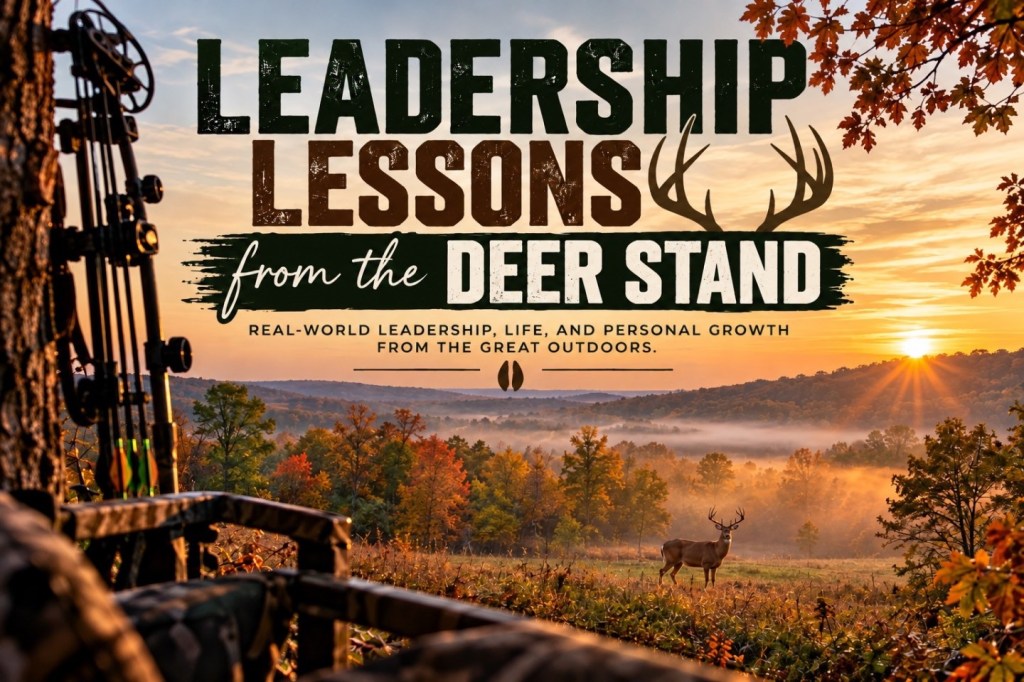
If you’ve spent much time deer hunting, you’ve probably experienced this more times than you’d care to admit.
You get up long before daylight.
You get dressed, gather your equipment, and head into the woods while most of the world is still asleep.
Maybe it’s freezing cold outside. Maybe the wind is blowing harder than you’d like. Or maybe it’s one of those mornings when your warm bed seems a whole lot more appealing than climbing into a deer stand.
But you go anyway.
You make your way to the stand, get settled in, and wait for the sun to come up.
Slowly, the woods begin coming alive.
You hear the leaves rustling.
A squirrel starts making enough noise that you’re convinced a deer must be walking through the woods.
You turn your head, look through the trees, and realize you’ve been fooled again.
Then you wait some more.
An hour passes.
Then another.
You watch the food plot.
You scan the tree line.
You keep thinking that any minute now, something is going to step out.
But nothing does.
Not a buck.
Not a doe.
Not even a little spike.
Just you, your deer stand, and a whole lot of time to think.
Eventually, you decide it’s time to climb down and head back to camp.
And after all that preparation, all that anticipation, and all those hours sitting in the woods, you’ve got absolutely nothing to show for it.
Or do you?
I’ve been thinking about that question.
Because I believe there’s an important lesson in those unsuccessful hunts.
And it might be one of the most difficult lessons we have to learn in leadership and life.
You Did Everything Right
Let’s go back to everything we’ve talked about throughout this series.
You spent the offseason preparing.
You planted the food plots.
You checked your stands.
You cleared the shooting lanes.
You serviced the feeders and checked the trail cameras.
You made sure your rifle or bow was ready.
You practiced.
You studied the conditions and picked a place where you believed you had a good opportunity to see deer.
You did everything you knew to do.
And still, nothing showed up.
That’s deer hunting.
And sometimes that’s life.
We spend a lot of time hearing about the relationship between hard work and success.
Work hard enough.
Stay focused.
Be disciplined.
Put in the effort.
And eventually, you’ll accomplish what you’re working toward.
There’s certainly some truth in that.
Hard work matters.
Preparation matters.
Discipline matters.
But here’s where I think we sometimes get things wrong.
We begin believing that if we do everything we’re supposed to do, we’re somehow guaranteed the outcome we want.
And that’s simply not how life works.
You can be a great employee and still not get the promotion.
You can build a business, provide excellent service, and still lose a customer.
You can invest time into a relationship and still experience disappointment.
You can make thoughtful decisions, work hard, and put everything you have into something, only to watch it turn out differently than you expected.
Sometimes you can do everything right and still come home empty-handed.
And that’s a difficult reality to accept.
Especially when you’re someone who believes in working hard and taking responsibility for your results.
When Hard Work Doesn’t Pay Off
I don’t know about you, but I like seeing results.
When I invest time, effort, and resources into something, I want to know that it’s making a difference.
I want to see progress.
I want to know that the work is accomplishing something.
And when it doesn’t, that can be frustrating.
As an entrepreneur, I’ve experienced situations where I’ve invested time and energy into ideas that didn’t turn out the way I hoped.
Sometimes you put together what you believe is a great plan.
You do the research.
You make the preparations.
You put in the hours.
You believe you’ve created something worthwhile.
And then you launch it.
And the response isn’t what you expected.
Maybe people aren’t interested.
Maybe the timing isn’t right.
Maybe circumstances change.
Or maybe there are things you simply couldn’t have predicted.
Whatever the reason, the results don’t come.
And suddenly, you’re left wondering what happened.
Was the idea wrong?
Did I make a mistake?
Should I have done something differently?
Was all that work a waste of time?
Those are real questions.
And I don’t think there’s anything wrong with asking them.
In fact, I think asking those questions can be part of becoming a better leader.
But here’s where we have to be careful.
An unsuccessful outcome doesn’t automatically mean the effort was wasted.
Sometimes the lessons we learn when things don’t work out become the very things that help us succeed later.
And sometimes the experience has value even if it never leads to the outcome we originally wanted.
Don’t Confuse Failure with Disappointment
I think there’s an important distinction between failure and disappointment.
They’re not always the same thing.
If you go deer hunting and don’t see a deer, were you a failure?
I don’t believe so.
You might be disappointed.
You might be frustrated.
You might wish you had chosen a different stand or stayed a little longer.
But the fact that a deer didn’t walk out in front of you doesn’t automatically mean you failed.
There are things outside your control.
You can’t force a deer to move.
You can’t make that trophy buck appear in your shooting lane.
You can’t control every change in the weather or every disturbance in the woods.
You can prepare, make informed decisions, and give yourself a reasonable opportunity.
But you cannot guarantee the result.
Leadership works the same way.
We have responsibilities.
We have decisions to make.
We have things we’re accountable for.
But we also have to recognize that not everything is within our control.
We can provide opportunities for our employees to grow, but we can’t force them to take advantage of those opportunities.
We can work hard to serve our customers, but we can’t control every decision they make.
We can do our best to lead people in the right direction, but we can’t make every person follow.
That doesn’t mean we stop trying.
It means we learn to distinguish between the things we’re responsible for and the things we cannot control.
And that’s a lesson I think many of us need to be reminded of.
You can be responsible for your effort without being in control of every outcome.
Sometimes You Need to Change Stands
Now, there’s another side to this lesson.
Just because an unsuccessful hunt doesn’t automatically mean you did something wrong doesn’t mean you should ignore the results.
If you’ve hunted the same stand several days in a row and haven’t seen any deer, maybe it’s time to evaluate what’s happening.
Perhaps the deer are moving differently than you expected.
Maybe the wind has been working against you.
Maybe the food plot isn’t attracting deer the way it did earlier in the season.
Or maybe you simply need to try another location.
There’s wisdom in being willing to make adjustments.
And I believe the same is true in leadership.
Sometimes things don’t work out because of circumstances beyond our control.
Other times, there are things we could do differently.
Maybe our approach needs to change.
Maybe our expectations aren’t realistic.
Maybe we haven’t communicated clearly.
Maybe we need to develop a new skill.
Or maybe we’re pursuing something that no longer makes sense for the season of life we’re in.
Those possibilities are worth considering.
But here’s the distinction I want to make.
Changing your approach isn’t the same thing as abandoning your purpose.
A hunter who decides to move to a different stand hasn’t necessarily given up on hunting.
He’s simply recognized that another approach might give him a better opportunity.
And a leader who adjusts a plan hasn’t necessarily abandoned the goal.
Sometimes making progress requires the willingness to admit that what we’re doing isn’t working and try something different.
That’s not weakness.
That’s learning.
The Danger of Measuring Everything by Results
We live in a world that loves results.
Sales numbers.
Revenue.
Promotions.
Awards.
Recognition.
Growth.
And don’t misunderstand me. Results matter.
If you’re running a business, you need to know whether it’s profitable.
If you’re leading a team, you need to understand whether you’re accomplishing your objectives.
If you’ve set a goal, you need some way of evaluating your progress.
I’m not suggesting that results aren’t important.
But I do think we can get into trouble when results become the only way we measure success.
Think about the hunter who spends an entire season in the woods and never harvests a deer.
If the only thing that matters is whether he brought home a buck, that season might feel like a complete failure.
But what if he learned something about the property?
What if he became a better hunter?
What if he spent meaningful time with his son or daughter?
What if he strengthened friendships around deer camp?
What if he simply enjoyed the opportunity to get away from the noise of everyday life and spend some time outdoors?
Do none of those things matter because he didn’t bring home a deer?
Of course they matter.
And I think we need to learn to recognize those kinds of victories in our everyday lives.
Maybe your business didn’t grow as much as you’d hoped this year, but you developed better systems and stronger relationships with your customers.
Maybe you didn’t get the promotion, but you became more capable and experienced in your current role.
Maybe a project didn’t work out, but you learned something that will help you avoid a costly mistake in the future.
Those things have value.
They may not have been the results you wanted.
But that doesn’t make them meaningless.
What Did You Learn While You Were Waiting?
One of the interesting things about sitting in a deer stand is how much time you have to think.
Especially when nothing is moving.
There’s no deer to watch.
No excitement.
No immediate reason to reach for your rifle or bow.
Just you and the woods.
And sometimes, in those quiet moments, you begin noticing things you might have missed otherwise.
You notice how the wind moves through the trees.
You hear sounds you wouldn’t have heard if you were rushing around.
You watch the woods change as the sun comes up.
You begin paying attention to things you normally overlook.
And occasionally, your mind wanders beyond hunting.
You think about your family.
Your work.
The decisions you’ve made.
The things you’re grateful for.
The things you wish you’d done differently.
I’ve come to appreciate those quiet moments.
Because life doesn’t give us many opportunities to sit still anymore.
We’re constantly moving.
Constantly checking something.
Constantly planning whatever comes next.
And when things aren’t happening as quickly as we’d like, our first instinct is often to get frustrated or find something else to do.
But maybe there’s value in learning to be still.
Maybe there’s something we can learn in the waiting.
And maybe not every quiet season of life is something we need to escape.
Sometimes we need to pay attention to what that season is teaching us.
Don’t Let an Empty Stand Make You Bitter
Here’s another thing I’ve seen happen in deer hunting.
Someone has a rough season.
They don’t see the deer they expected.
Maybe they miss an opportunity.
Maybe somebody else harvests the buck they’ve been watching all year.
And suddenly, they’re frustrated with everything.
The weather.
The property.
The other hunters.
The deer.
Everything.
Now, I understand disappointment.
There’s nothing wrong with wanting something and feeling frustrated when it doesn’t happen.
But if we’re not careful, disappointment can begin affecting our attitude.
And that attitude can follow us long after the hunt is over.
I think the same thing happens in leadership.
We experience setbacks.
Things don’t go our way.
Someone else gets the opportunity we wanted.
A plan falls apart.
And before long, we begin allowing those disappointments to influence how we treat the people around us.
We become negative.
We become impatient.
We stop appreciating what we do have because we’re so focused on what didn’t happen.
And sometimes we begin approaching every new opportunity with the expectation that it probably won’t work out anyway.
That’s a difficult place to be.
Because disappointment is part of life.
But bitterness doesn’t have to be.
We can acknowledge that something didn’t work out without allowing it to determine how we approach everything that comes next.
We can be disappointed without becoming defeated.
And we can learn from an unsuccessful experience without allowing it to convince us that trying again is pointless.
Tomorrow Is Another Hunt
One of the things I appreciate about deer hunting is that an unsuccessful morning doesn’t necessarily mean the season is over.
You climb down from the stand.
You head back to camp.
Maybe you grab something to eat, talk with the other hunters, and find out whether anybody else saw anything.
You think about what happened.
You consider whether you need to make any adjustments.
And if the season is still open, you’ve got another opportunity to go back out.
Maybe that afternoon.
Maybe the next morning.
And who knows?
The deer that never showed up today might walk right out tomorrow.
There’s no guarantee.
But there’s still an opportunity.
I think we need to remember that in life.
One disappointing outcome doesn’t have to define the rest of our journey.
One failed business idea doesn’t mean you’ll never build something successful.
One missed opportunity doesn’t mean another will never come.
One difficult season doesn’t mean every season ahead will be the same.
Sometimes we need to evaluate what happened, learn what we can, make adjustments, and give ourselves permission to try again.
And sometimes we need to recognize that even if the outcome never changes, the effort may still have been worthwhile.
Because the value of an experience isn’t always found in what we bring home.
Sometimes it’s found in who we become along the way.
Was It Really an Unsuccessful Hunt?
As I think about those mornings when nothing shows up, I keep coming back to one question.
Was the hunt really unsuccessful?
If your only goal was to harvest a deer, you might say yes.
And I understand that.
But maybe there’s more to it.
Maybe you learned something about yourself.
Maybe you practiced patience.
Maybe you recognized something that needs to change.
Maybe you had time to think about things you’ve been too busy to consider.
Or maybe you simply enjoyed a few quiet hours in the woods.
None of those things puts venison in the freezer.
And they certainly don’t give you a trophy to hang on the wall.
But that doesn’t mean they don’t matter.
I’ve come to believe that success is sometimes much bigger than the outcome we originally set out to achieve.
And while I still believe in setting goals, working hard, preparing, and doing everything we reasonably can to accomplish what we’re pursuing, I also believe we have to learn how to handle the moments when those things don’t produce the results we wanted.
Because sooner or later, every one of us is going to experience a season when nothing seems to show up.
And when that happens, I hope we remember this:
You can do everything right and still come home empty-handed. But coming home empty-handed doesn’t mean you have to come home with nothing.
Sometimes you bring home a lesson.
Sometimes you bring home a memory.
Sometimes you bring home a little more patience, a little more perspective, or a better understanding of what matters.
And sometimes those things are worth more than we realize.
That’s another lesson I’ve learned from the deer stand.
And one I think we all need from time to time.
Something to Think About
How do you respond when you’ve done everything you know to do, but the results still don’t come?
Do you allow disappointment to define the experience, or do you look for what you can learn from it?
And is there something in your life right now that feels unsuccessful simply because it hasn’t turned out the way you expected?
I’d love to hear your thoughts.
This is Week 7 of Leadership Lessons from the Deer Stand, an eight-week series by Kris Logsdon exploring leadership, life, faith, and personal growth through experiences and observations from the deer woods.
Join me every Thursday for another lesson from the deer stand.

