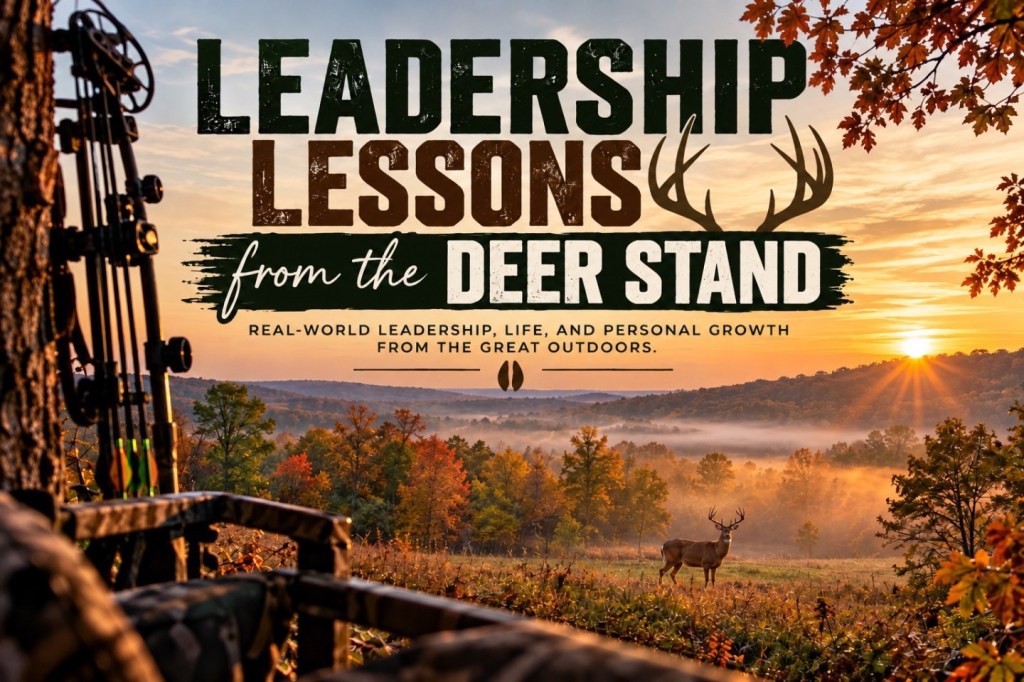
Leadership Lessons from the Deer Stand | Week 3
Walk into just about any sporting goods store during deer season, and you’ll find an entire section dedicated to helping hunters become more successful.
Rifles, bows, scopes, rangefinders, binoculars, trail cameras, camouflage, boots, tree stands, and more accessories than most of us probably need.
And if you’ve spent much time hunting, you’ve probably convinced yourself at some point that you needed at least a few of those things.
I know how easy it is to walk into a hunting store looking for one thing and leave wondering how you managed to spend so much money.
But here’s something I’ve been thinking about.
Almost everything we take into the deer woods serves a purpose.
We don’t carry a rifle or bow just because we enjoy hauling extra weight through the woods. We carry it because it’s the equipment we’ll use to harvest a deer.
We wear camouflage to help conceal ourselves. We use binoculars to get a better look at what we’re seeing. We use rangefinders to help determine distance. We invest in boots and clothing that help us stay comfortable when we’re sitting outside in the cold for hours.
Some of that equipment is necessary. Some of it makes the experience easier. And some of it, if we’re being truthful, is probably something we bought because it looked pretty cool.
But the goal is generally the same.
We want to be equipped for the hunt.
And the more I think about that, the more I realize there’s a lesson here that reaches far beyond the deer woods.
The Right Tools for the Right Job
Think about how we prepare for a hunt.
If we’re going to be bowhunting, we don’t grab a rifle and head into the woods expecting to use it during archery-only season.
If we’re hunting from a stand twenty feet above the ground, we need the proper equipment to get into that stand safely and remain secured while we’re there.
If we’re hunting in freezing temperatures, we’re probably not going to wear the same clothing we’d wear on a warm afternoon in early October.
We choose our equipment based on what we’re trying to accomplish and the conditions we expect to encounter.
That makes sense, doesn’t it?
But how often do we approach life without giving much thought to the tools and skills we’ll need to accomplish our goals?
We say we want to become better leaders.
We want to grow a business.
We want to become better parents, spouses, mentors, or simply better versions of ourselves.
Those are all worthwhile goals.
But sometimes we spend more time dreaming about the outcome than considering what we’ll need to get there.
A hunter preparing for deer season thinks about where he’s hunting, what equipment he’ll need, and how he’s going to use it.
Maybe we ought to give our own goals that same level of attention.
Because if you don’t know what you’re pursuing, it’s pretty difficult to know what you’ll need along the way.
Having the Equipment Doesn’t Make You a Hunter
Now, here’s where things get interesting.
You can spend thousands of dollars on hunting equipment.
You can have the most expensive rifle on the market, a high-dollar scope, the latest trail cameras, and a bow that looks like something out of a science fiction movie.
But none of that automatically makes you a good hunter.
You can own a great rifle and still be a terrible shot.
You can have a bow with every accessory imaginable and still struggle to hit a target consistently.
You can buy a rangefinder, but if you’ve never learned how to use it properly, it’s not going to do you much good.
Having the equipment and knowing how to use it are two completely different things.
And I think we see this same problem in leadership.
We collect tools.
We buy books. We attend conferences. We listen to podcasts. We download apps and invest in programs that promise to help us become more effective.
And don’t get me wrong. I believe strongly in learning and personal development.
After all, a big part of my own mission is to help people grow and become better today than they were yesterday.
But I’ve also learned that information doesn’t automatically become ability.
You can read ten books about communication and still struggle to have an honest conversation with someone.
You can attend a leadership conference and come home with a notebook full of great ideas, but if you never apply any of them, what has actually changed?
You can invest in all the latest technology for your business and still struggle if you haven’t developed the discipline and skills needed to use it effectively.
Owning the tools doesn’t mean you’ve developed the skills.
And sometimes we need to stop looking for another tool and start getting better with the ones we already have.
The Importance of Practice
Before deer season begins, there’s something every responsible hunter should take seriously.
Practice.
If you’re hunting with a rifle, you need to make sure it’s properly sighted in. You need to know where that bullet is going to hit when you squeeze the trigger.
If you’re bowhunting, you need to check your sights, make sure your pins are adjusted, and spend time shooting.
And not just once.
You practice until you’re comfortable and confident in your ability.
Because when that trophy buck finally steps out into your shooting lane, you don’t want that to be the first time you’ve used your equipment in months.
That moment isn’t the time to discover your scope is off or your bow isn’t shooting the way you expected.
And it certainly isn’t the time to start learning the basics.
The same principle applies to leadership.
You don’t become a good leader simply because someone gives you a title.
You don’t automatically become a great communicator because you’re put in charge of people.
And you don’t develop good decision-making skills just because you’ve been given the authority to make decisions.
Those abilities are developed over time.
Through practice.
Through experience.
Through mistakes.
Through learning what works, what doesn’t, and what you need to do differently.
I’ve learned plenty of lessons in my own leadership journey that didn’t come from a classroom or a book.
They came from situations where I had to make a decision, have a difficult conversation, or figure something out when things weren’t going according to plan.
And I haven’t always gotten those things right.
But each experience has given me an opportunity to learn something I didn’t know before.
That’s how we grow.
Not simply by knowing what we’re supposed to do, but by actually doing it.
Don’t Confuse Expensive with Effective
There’s another side to all this equipment that I think is worth talking about.
Somewhere along the way, it’s easy to start believing that having the most expensive gear gives us the best chance of success.
And while quality equipment certainly has its place, more expensive doesn’t always mean more effective.
I’ve known hunters who could take a fairly basic rifle, one they’d been shooting for years, and shoot better than someone carrying a rifle that cost several times as much.
Why?
Because they knew their equipment.
They’d spent time practicing. They understood how it performed. They were comfortable with it.
They didn’t need the latest and greatest thing to be effective.
I think we sometimes forget that in business and leadership.
We start believing that if we just had a better system, a newer piece of technology, another certification, or one more resource, we’d finally be able to accomplish what we’re trying to do.
Maybe those things would help.
But maybe the answer isn’t another purchase.
Maybe it’s learning how to make better use of what we already have.
A small business owner doesn’t always need the same resources as a large corporation to provide great service.
A leader doesn’t have to have an expensive office, an impressive title, or a wall full of awards to make a difference in someone’s life.
And a parent doesn’t need to have all the answers to be a positive influence on their children.
Sometimes the most effective tools are the simplest ones.
Listening.
Showing up.
Keeping your word.
Being willing to learn.
Taking responsibility when you make a mistake.
Those things might not be as exciting as the latest technology or the newest leadership program.
But they still work.
And they’ll probably never go out of style.
Being Equipped Means Being Prepared for Responsibility
Now, I want to bring this back to the hunt for a moment.
There’s an important responsibility that comes with carrying a rifle or bow into the woods.
It’s not simply about whether we can harvest a deer.
It’s about whether we can do so safely, responsibly, and ethically.
We have to know our equipment.
We have to understand its limitations.
We have to know when a shot is appropriate and when it isn’t.
And sometimes, even when a deer is standing right in front of us, the responsible decision is not to take the shot.
Maybe the distance is farther than we’re comfortable with.
Maybe there’s an obstruction.
Maybe we simply don’t have a clear, safe opportunity.
Whatever the reason, knowing when not to act is just as important as knowing how to act.
That’s an important lesson for leadership, too.
Just because we have the ability to do something doesn’t necessarily mean it’s the right thing to do.
Just because we have authority doesn’t mean we should exercise it without considering the consequences.
Just because an opportunity presents itself doesn’t mean we have to pursue it.
Being equipped isn’t simply about having the resources and ability to act.
It’s also about developing the judgment to know when, how, and whether we should act.
And sometimes that takes more discipline than making the decision to move forward.
What Are You Carrying Into Your Next Season?
As you think about your own life, I want you to consider something.
What are you currently pursuing?
Maybe you’re working toward a leadership position.
Maybe you’re trying to grow your business.
Maybe you’re working on becoming a better spouse, parent, or friend.
Or maybe you’re in a season of life where you’re trying to figure out what comes next.
Whatever you’re pursuing, ask yourself a few questions.
Do I have the tools I need?
Do I know how to use them?
Am I developing the skills necessary to accomplish what I’m working toward?
And perhaps most importantly, am I actually putting those skills into practice?
Because here’s the thing.
You can walk into the woods carrying every piece of hunting equipment imaginable and still come home empty-handed.
And you can do everything right and still not get the opportunity you were hoping for.
We’ve already talked about that in this series.
Preparation doesn’t guarantee success.
But the right equipment, combined with the knowledge, discipline, and experience to use it, can help put us in a better position when the opportunity arrives.
And I think that’s something worth remembering.
The tools don’t accomplish the mission. They help equip the person responsible for accomplishing it.
So before you go looking for the next tool, the next program, or the next thing you think you need to succeed, take a moment and consider what you already have.
Maybe you don’t need more equipment.
Maybe you just need more practice.
That’s another lesson I’ve learned from the deer stand.
And one that applies long after hunting season is over.
⸻
Something to Think About
Are you spending more time collecting tools for success or developing the skills to use the tools you already have?
What’s one skill you could begin practicing today that would make you better prepared for the opportunities you’re pursuing?
I’d love to hear your thoughts.
⸻
This is Week 3 of Leadership Lessons from the Deer Stand, an eight-week series by Kris Logsdon exploring leadership, life, faith, and personal growth through experiences and observations from the deer woods.
Join me every week for another lesson from the deer stand.

